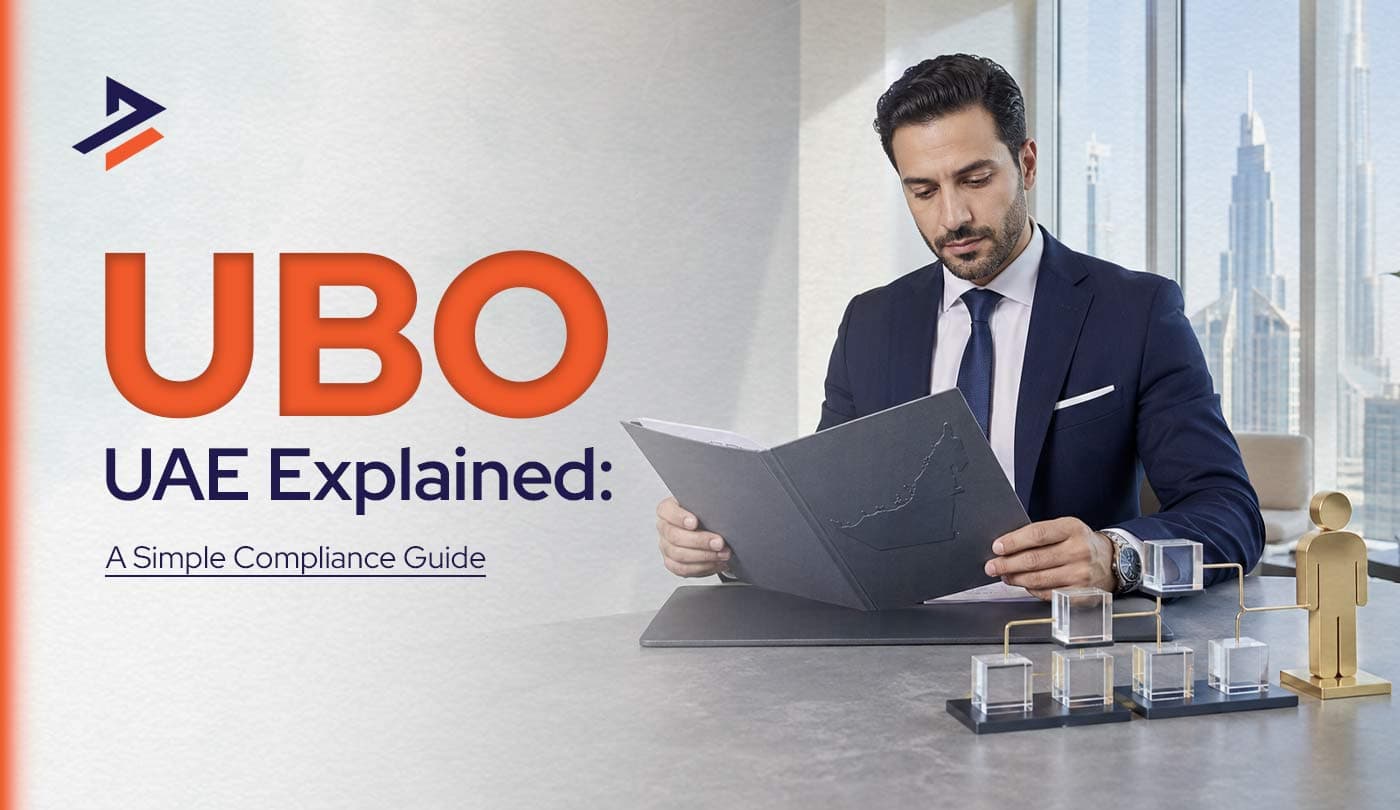
Understanding Ultimate Beneficial Ownership UAE is no longer just a compliance formality, it’s a fundamental legal requirement that can directly affect everything, from trade license renewals to the ability to open a corporate bank account.
This guide explains what UBO registration UAE is, how to identify one even within the most complex ownership structures, what the law requires, the consequences of getting it wrong, and some practical questions around UBO UAE compliance.
What is UBO in UAE?
An Ultimate Business Owner UAE is a natural person who ultimately owns or controls a company, even if they are not known as the owner of the business or named on the trade license. Under UAE law, a person qualifies as a UBO if they meet any of the following conditions:
- Own 25% or more of the company’s shares or capital, directly or indirectly.
- Hold 25% or more of the voting rights.
- Hold the right to appoint or dismiss the majority of the company’s managers or directors.
- Exercise ultimate effective control over the company through any other means.
If no individual meets any of these criteria, the senior management officer, typically the general manager, is deemed the Ultimate Beneficial Owner by default.
Importance of UBO checks in the UAE
UBO UAE checks play a crucial role in promoting corporate transparency, regulatory compliance, and financial security. They help businesses operate with integrity and prevent financial crimes such as money laundering, fraud, and tax evasion.
- Compliance with Global & UAE Regulations – Enforcement of strict UBO disclosure laws helps prevent financial crimes, fines, license suspension, and reputational damage.
- Preventing Money Laundering & Financial Crimes – UBO checks help trace assets, identify illicit activities like fraud, corruption, and terrorist financing, and prevent them.
- Enhancing Business Trust & Reputation – Transparency in business ownership builds trust, ensures financial approvals, and gives companies an advantage through ethical practices and accountability.
- Strengthening Due Diligence & Risk Management – UBO checks help mitigate risks and avoid dealings with high-risk entities, PEPs, or sanctioned individuals.
- Avoiding Regulatory Penalties & Legal Risks – Non-compliance with UBO regulations can result in fines up to AED 100,000, business suspension, and reputational damage.
The legal basis — Ultimate Beneficial Ownership regulations
The legal framework of Ultimate Beneficial Ownership UAE has evolved in stages. Here’s the accurate chain:
- Federal Decree-Law No. 20 of 2018 – Lays the foundation for the Anti-Money Laundering (AML) and Countering the Financing of Terrorism (CFT) framework.
- Cabinet Decision No. 58 of 2020 — Introduced the first detailed UBO procedures.
- Cabinet Decision No. 109 of 2023 — The current governing Ultimate Beneficial Ownership regulations for registration, disclosure, and filing procedures.
- Cabinet Decision No. 132 of 2023 — Discloses the administrative penalty framework for non-compliance.
- Federal Decree-Law No. 10 of 2025 — The updated rules for AML/CFT/CPF (Counter-Proliferation Financing), which reinforces risk-based UBO identification, particularly for DNFBPs (Designated Non-Financial Businesses and Professions) and VASPs (Virtual Asset Service Providers).
If the company has filed its UBO declaration UAE before 2023, it must ensure that its registration still aligns with Cabinet Decision 109 rather than the earlier 58/2020 procedures, as the governing instrument has changed.
The objective is to prevent the use of shell companies and opaque ownership structures to launder money, finance terrorism, or evade taxes, and to align the UAE with international financial transparency standards set by bodies like the Financial Action Task Force (FATF).
Worked examples: Identifying UBO in UAE
Definitions can be hard to apply. So, here are a few examples of how the 25% rule actually plays out in real ownership structures:
Example 1 – Direct ownership
Ahmed owns 60% of Falcon Trading LLC. Since he crosses the 25% threshold directly, he qualifies as the UBO.
Example 2 – Indirect ownership through a holding company
Falcon Holdings Ltd, a foreign holding company, owns 100% of Falcon Trading LLC. Sara owns 80% of Falcon Holdings Ltd but holds no shares directly in the UAE entity. Therefore, her name does not appear anywhere on the trade license. However, she would be identified as the UBO of Falcon Trading LLC since she controls the holding company that owns Falcon Trading LLC.
Example 3 – No one crosses the 25% threshold
Sometimes, ownership is split finely – four partners at 25% each. In such a case, the test shifts to control by other means. For instance, who can appoint or dismiss most managers, or who holds the ultimate decision-making power? If that still doesn’t identify a clear individual, the senior management officer is deemed the UBO by default.
Who has to comply: Ultimate Beneficial Owner UAE law
UBO requirements UAE apply across the country, but the filing authority and procedure differ depending on where the company is registered.
| Mainland | Free Zone | Offshore | DIFC / ADGM | |
|---|---|---|---|---|
| Governed by | Cabinet Decision 109/2023 | Cabinet Decision 109/2023 | Cabinet Decision 109/2023 | Their own separate financial free zone framework |
| Filing authority | Department of Economy and Tourism / Economic Development | The relevant Free Zone authority | Registered agent / registry | DIFC Registrar / ADGM Registration Authority |
| Subject to federal UBO rules? | Yes | Yes | Yes | No — generally exempt, as they are financial free zones with independent regulatory regimes |
Government-owned entities are also exempt from the UBO filing UAE. Every company in the country must comply, whether it’s 100% foreign-owned or has a single founder.
The filing process: UBO registration UAE
The process of UBO filing UAE may vary depending on the jurisdiction of the business – the mainland, a free zone, or offshore. The general steps to file the UBO declaration form UAE include:
- Identify the UBO(s) using ownership and control.
- Prepare and maintain the Register of Beneficial Owners, the Register of Partners/Shareholders, and the Register of Nominee Directors.
- File the UBO declaration with the relevant licensing authority.
- Businesses must keep their information current and report any changes in beneficial ownership to prevent any non-compliance risks.
Deadlines to know – UBO declaration Dubai
File the initial UBO declaration after company registration – within 60 days
Report any change in beneficial ownership to the registrar – within 15 days
Respond to any additional information request from the authority – within 14 days
Correction after a first-violation written warning – 30 days window
Nominee shareholders and directors: What actually goes on the register?
Nominee arrangements are legal in the UAE, but they don’t offer privacy from the UBO framework. If one person holds shares or a director’s seat on behalf of another, it must be disclosed, and the real person they act for must still be identified as the UBO. The nominee’s name may appear on the trade license or corporate documents, but the UBO register will reflect the actual beneficiary. This rule applies regardless of how paperwork is structured on the surface.
Penalties for non-compliance: UAE UBO register
Under Cabinet Decision No. 132 of 2023, the penalties escalate in the following ways:
| Violation | Consequence |
|---|---|
| 1st Violation | Written warning, with 30 days to correct the issue |
| 2nd Violation | Fine of up to AED 50,000 |
| 3rd Violation |
Fine of up to AED 100,000, plus license suspension for up to 12 months |
| Providing False or Misleading Ownership Information |
Criminal penalties, plus fines starting from AED 20,000, with potential imprisonment |
Beyond the direct fines, non-compliance can block license renewal, which can become a big operational concern for business owners.
Ultimate Beneficial Owner KYC: Why it matters?
UBO compliance is not merely a regulatory box to tick. Under the AML/CFT regime, banks in the UAE are required to identify and verify the beneficial owners of every corporate customer as part of Know Your Customer (KYC) and Customer Due Diligence (CDD) procedures, reported through the Financial Intelligence Unit’s goAML system.
An incomplete, outdated, or inconsistent KYC beneficial owner register doesn’t just risk a fine – it can stall a corporate bank account application, delay a banking relationship, or trigger enhanced due diligence, slowing down day-to-day transactions. Businesses using complex layers for privacy may trigger the closest scrutiny.
Stay compliant with UBO requirements UAE
Ultimate Beneficial Ownership UAE compliance is a standing obligation to keep the registers accurate as ownership changes. Whether you are starting a new company or evaluating an existing structure, getting the ownership chain right helps avoid escalating penalties, protects the license renewal, and keeps banking relationships smooth.
Nevertheless, if you are unsure who qualifies as the Ultimate Beneficial Owner Dubai in your company, or your ownership structure involves holding companies, trusts, or nominee arrangements, it’s worth getting this properly reviewed rather than making assumptions.
Connect with Dubiz Consultancy
Our team of consultants can walk through your specific structure and help you register your UBO UAE. In addition, they will guide you on other crucial aspects of UBO, such as how to get UBO in UAE, KYC ultimate beneficial owner, and more.
Book a free consultation with Dubiz Business Setup advisors and get a comprehensive guide on Ultimate Business Owner UAE.
Call: +971 56 369 5485
WhatsApp: +971563695485
Email: info@dubiz.co
Disclaimer: This article is for general guidance only. Ultimate Beneficial Ownership UAE regulations are subject to change. Therefore, always confirm current requirements with a qualified compliance advisor.
Frequently asked questions
Q1. What if the company ownership is split 50/50 between two people with no tiebreaker?
Where no individual crosses the 25% threshold or otherwise exercises clear control, the control-by-other-means test applies, and the senior management officer is deemed the Beneficial Owner UAE by default.
Q2. Can a foreign trust be a shareholder? If so, then who is the UBO?
Yes, trusts can hold shares. The UBO analysis examines the trustee’s control versus the beneficiary’s entitlement, and both may need to be considered the UBO, depending on the structure.
Q3. What if the beneficial owner is a minor?
A minor can technically hold Ultimate Beneficial Ownership UAE. In practice, the legal guardian or representative will handle the filing obligations on their behalf.
Q4. Does a UBO have to be a UAE resident?
No. A UBO can be a foreign national living outside the UAE. Nationality and residency are not eligibility criteria.
Q5. What’s the difference between what’s on the trade license and what’s on the UBO register?
The trade license reflects the record of registered shareholder(s), which may include a corporate entity or a nominee, whereas the UBO register reflects the natural person(s) behind that structure. Both documents can show different names, which is exactly the gap the UBO framework exists to close.