
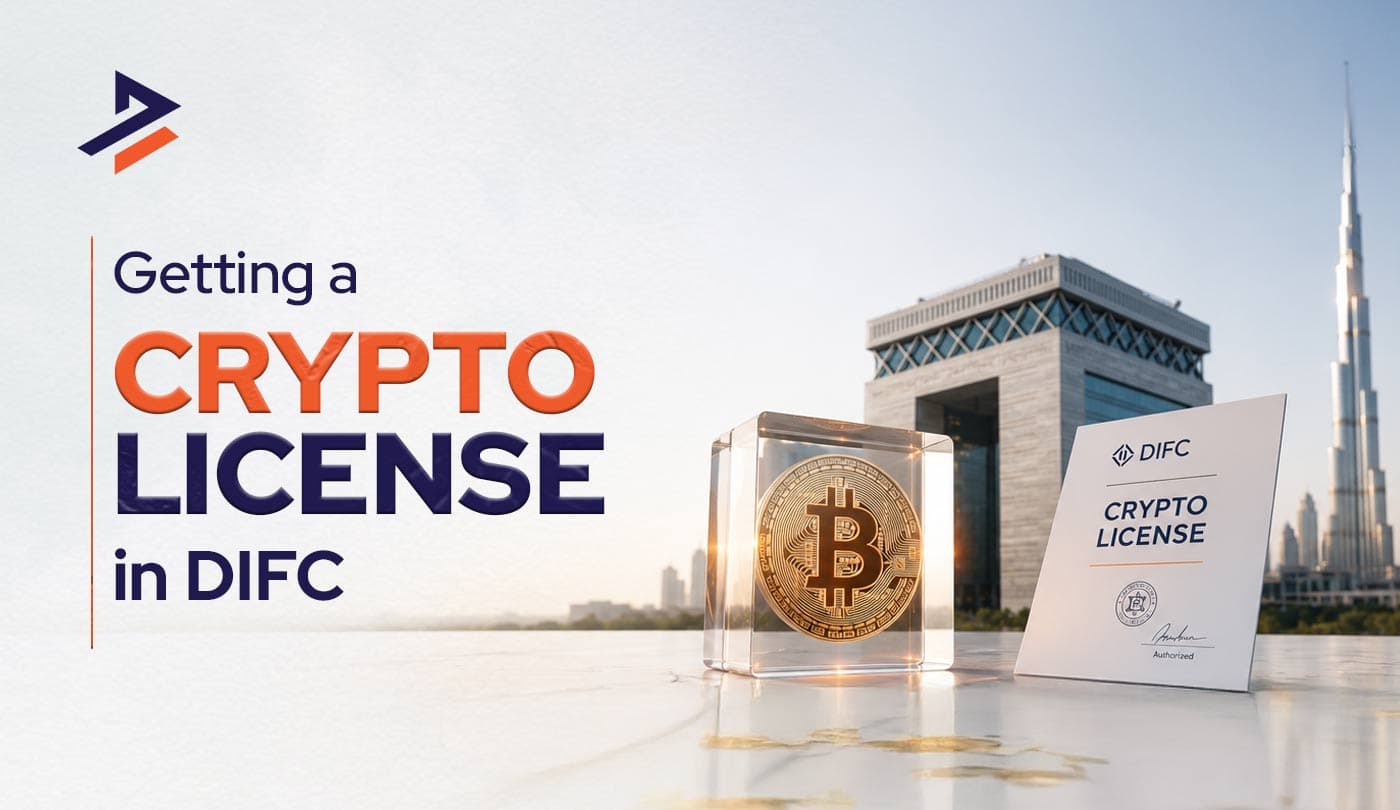
Dubai Financial Services Authority (DIFC), located across 110 hectares in central Dubai, offers the most enabling environment for blockchain, fintech, digital assets, and crypto ventures. Most popular is a DIFC crypto license which allows crypto trading, brokerage, custody services, and digital asset advisory, issued by Dubai Financial Services Authority (DFSA). And it comes with 100% ownership and zero corporate tax.
For anyone looking to establish a crypto business in DIFC, this comprehensive guide mentions everything – DIFC crypto license types, the application process, legal eligibility, costs, and required paperwork. Read the explainer to confidently start your digital asset company right in the heart of Dubai.
Meaning of DIFC crypto license
A DIFC crypto license is issued by the DFSA, allowing institutional crypto traders, custodians, brokers, and asset managers to operate in and from DIFC, a financial free zone in Dubai, UAE.
Dubai Financial Services Authority (DIFC) is the region’s largest financial ecosystem, competing with Singapore, Hong Kong, and New York. It operates under English Common Law principles that align with the strongest international financial rules and investor protection standards. As a result, it is globally respected and chosen by leading financial institutions such as JPMorgan, BlackRock, and Schroders.
Key info: DIFC license ideally suits “institutional crypto companies,” those businesses who plan to work with high-net-worth entities and financial institutions. When dealing with retail clients, additional obligation applies.
Regulatory framework for DIFC crypto businesses
DIFC laws are completed separate from mainland, Dubai. DIFC has its independent rule book for financial sector, whereas mainland is regulated by VARA.
In DIFC, we have Dubai Financial Services Authority, aka, DFSA.
DIFC Law No. 1 of 2004 grants the DFSA its powers as a financial and crypto services regulator in DIFC free zone. The DFSA established a crypto token regime in 2022 and frequently updates its regulations to keep crypto trading environment secure, transparent, and investor-friendly.
Here are the general rules related to DIFC crypto business:
Dealing in recognised tokens: Only those crypto tokens which are recognised by the DFSA can be used in DIFC such as Bitcoin, Ethereum, Litecoin, Toncoin, and Ripple. Privacy tokens and algorithmic tokens are prohibited for any kind of use.
UAE Central Bank requirements: When offering services such as payments and token transfer solutions, both DFSA and UAE Central Bank regulations must be met.
AML/KYC/CFT compliance: All crypto firms must strictly implement systems for monitoring the source and use of crypto funds. Transactions must be continuously monitored, and any suspicious activity should be reported.
Capital adequacy: Some crypto activities require maintaining minimum paid-up capital on a continuous basis. Advisory licenses have lower capital requirements than trading or custody licenses.
Cybersecurity protocols: It is the firm’s responsibility to protect crypto funds from hacking, phishing, ransomware, and insider attacks. Multi-factor authentication (MFA), multi-signature wallets, and encryption standards must be diligently followed.
Activities covered under a DIFC crypto license
When applying for a crypto license in DIFC, you need to clearly define your activity scope to the DFSA. Here are the common crypto-related activities for which the DFSA issues licenses:
- Crypto trading and brokerage: You can trade, buy, sell, or invest in recognized crypto tokens as a principal or as an agent on behalf of clients.
- Advising on financial products: Those with sufficient and proven knowledge and expertise can offer advisory to businesses, clients, and traders related to crypto investments.
- Crypto custody and wallet services: To offer custody services, you must implement recommended cyber-security measures, including cold storage and hot storage.
- Asset management (digital asset funds): Involves managing digital asset portfolios for professional clients like hedge funds, venture funds, etc.
- Crypto asset exchange (Multilateral Trading Facility, MTF): Operate a trading platform where users can buy, sell, or exchange cryptocurrencies or digital assets.
- Crypto payments solutions: Set up a crypto payment gateway or settlement platform where merchants can accept crypto payments locally and internationally.
Depending on the activity you choose, you may need to comply with particular legal requirements established by DFSA.
Benefits of crypto business in DIFC
More than 8,000 companies operate in the DIFC because of the many benefits the free zone offers. Dubai ranks 11th globally in the Global Financial Centres Index (GFCI), and the DIFC has helped position Dubai among the world’s top four financial hubs.
Here is why DIFC is the best choice for launching a crypto business in 2026.
Benefits of business setup:
- Cost-efficient business setup
- 0% corporate tax on qualifying income
- 100% foreign business ownership
- Transparent and independent common law judicial system
- Strategic location in the heart of Dubai
Business growth opportunities:
- A hub for ultra-high-net-worth individuals
- The region’s largest talent pool for financial services
- Hosts major industry events, such as the Dubai FinTech Summit, Hedge Fund Managers Middle East Summit, and IPEM Future 2026
- International credibility and investor confidence
- Access to wealth and asset management companies, AI, fintech, innovation firms, and leading banks for networking and business opportunities
Step by step process of obtaining a DIFC crypto license in Dubai, UAE
Setting up a crypto company in DIFC involves the following steps:
Step 1 – Determine your crypto activities:
Identifying your crypto business activities is crucial, as the DFSA has specific requirements for each. If you are unsure, we advise you to reach out to our business setup consultants in Dubai.
Step 2 – Choose a DIFC legal structure:
You can establish a limited liability company (LLC), a partnership firm, or another legal structure as permitted by the Dubai Financial Services Authority (DIFC). Each structure has its own set of rules and tax responsibilities.
Step 3 – Apply for DFSA authorisation:
To start and operate a crypto business, you need in-principle approval from the DFSA. Submit your business plan and application to the DFSA, which will then issue an approval certificate and a draft licence.
Step 4 – Register your office address:
Choose and register the office space where your crypto business will operate in the DIFC.
- For leased property: Register the lease agreement with the DIFC Registrar of Real Property.
- For a purchased unit: The sole shareholder or the company must own the property.
Step 5 – Register your company with the DIFC Registrar:
After obtaining DFSA in-principle approval and the draft licence, complete the company registration formalities with the DIFC Registrar of Companies. You must submit:
- Details of partners/shareholders
- Constitutional documents (Memorandum of Association and Articles of Association)
Upon successful registration, your Certificate of Incorporation and DIFC crypto licence in Dubai will be issued.
Step 6 – Set up banking account:
Open a corporate bank account in the UAE for your business. As part of the due diligence process, you will be asked to provide your DIFC licence, compliance paperwork, and company documents.
Step 7 – Obtain the necessary visas:
If required, apply for an investor visa for yourself, employee visas for your staff, and family visas for your dependants. The visa quota often depends on your office size or business package.
Ongoing compliance for DIFC crypto companies
Holding DIFC crypto license comes with the responsibility of law adherence, with common compliances including:
- Regular reporting: Submit period financial reports to DFSA showing your transaction volumes, clients, liquidity, and financial positions.
- Capital adequacy: Maintain minimum capital levels based on license crypto activity. Shortcomings are not accepted and may need clarification.
- System updates: Rish management, asset security, AML/CFT compliance, and KYC systems should be up to date.
Incident reporting: Any transaction breaches, client complaints, and cybersecurity issues must be immediately reported to DFSA.
Cost of DIFC crypto license
On an average, a DIFC crypto license costs around USD 31,660* including a business license, one-time registration fee, trade name reservation, flexi desk, and essential PRO services.
DIFC crypto license cost breakdown:
| Cost component | Fee* (USD) |
| Business license | 12,000 |
| Trade name reservation | 200 |
| Incorporation fee | 9,000 |
| Flexi desk | 6460 |
| PRO services | 4000 |
| Total | 31,660* |
Please note that there may be additional costs such as:
- Visa processing fee
- Capital deposit held with bank
- Corporate bank account opening
Total investment amount varies by license type and business complexity. For proper budgeting and financial planning, investors can reach out to our business setup experts.
Documents required for DIFC crypto license application
Here are the documents you generally need to set up a crypto business in the Dubai Financial Services Authority (DIFC):
- Detailed business plan
- Compliance manual
- Risk management policies
- Capital adequacy calculations
- Details and CVs of key business personnel
- Passport copies of key individuals in the business
- Proof of financial capacity and capital
- Trade name reservation
- Constitutional documents, such as MoA and AoA
Note: Documentation requirements may vary and are subject to regulatory changes made by the DIFC and the DFSA.
Get your DIFC crypto license with Dubiz
Dubiz Business Setup is trusted by 7,000+ global clients for business setup, visas, bank account opening, and legal compliance in Dubai and across the UAE. With our specialization in free zones, our experts can help you establish your crypto business in the DIFC with utmost care, speed, and minimal hassle.
From approvals and office arrangements to paperwork, visas, UAE bank account opening, tax, and accounting, everything will be handled by us. To discover our latest offers or seek any additional information, you can reach out to us anytime.
Call: +971 56 369 5485
WhatsApp: +971 56 369 5485
Email: info@dubiz.co
Frequently Asked Questions (FAQs)
Q1. Does VARA regulate a DIFC crypto licence?
No. VARA regulates crypto activities in Dubai mainland. In the DIFC, crypto businesses are regulated by the DFSA.
Q2. Is DIFC a good choice for a crypto business?
Yes. The DIFC is among the world’s top four financial hubs, offering a tax-efficient and conducive environment for crypto business setup.
Q3. How long does it take to get a DIFC crypto business licence?
A DIFC crypto business setup may take around 4 weeks, depending on approvals, documentation, and the complexity of the business.
Q4. Where else can you get a crypto licence other than in the DIFC?
Besides the DIFC, you can obtain a crypto licence in Dubai mainland, Dubai Multi Commodities Center (DMCC), Abu Dhabi Global Market (ADGM), Dubai World Trade Center (DWTC), and International Free Zone Authority (IFZA).