
Choosing the right business structure in UAE, whether a Limited Liability Company (LLC), sole proprietorship, branch, or other, is a crucial step in company formation that requires careful attention. If you are only focusing on cost, you are thinking narrowly. Your personal liability, tax responsibilities, and future business growth all depend on your business’s structure.
Thus, while selecting a legal structure, analyse:
- The various legal structures available in the UAE.
- What liability arises for you under each.
- Taxes, along with the cost of various structures.
Based on Dubiz’s industry experience and current UAE regulations, this guide simplifies understanding the different types of company structures in UAE.
Why Choosing the Right Business Structure in UAE Matters?
From your day-to-day operations to your taxes, ownership rights, and personal asset risks – everything is influenced by the legal structure of your business in UAE.
Important notice: What our Dubiz experts have observed is that investors often lack clarity and make hasty decisions. As a result, many end up restructuring within just a few years, costing them time and money. At Dubiz, we prefer having a 1:1 consultation before beginning company formation to help you pick the best-fit structure.
Your business’s legal structure should give you the right mix of legal protection and benefits. Choose the one that:
- Keeps your personal assets safe
- Gives you room to grow in your industry
- Helps you manage taxes smartly
- Makes decision-making quick and smooth
- Fits your budget without stress
Types of Business Structures in UAE: Comparison Table for Choosing
The most chosen business structures in the UAE include sole proprietorship, a limited liability company, and a branch. But these are not all.
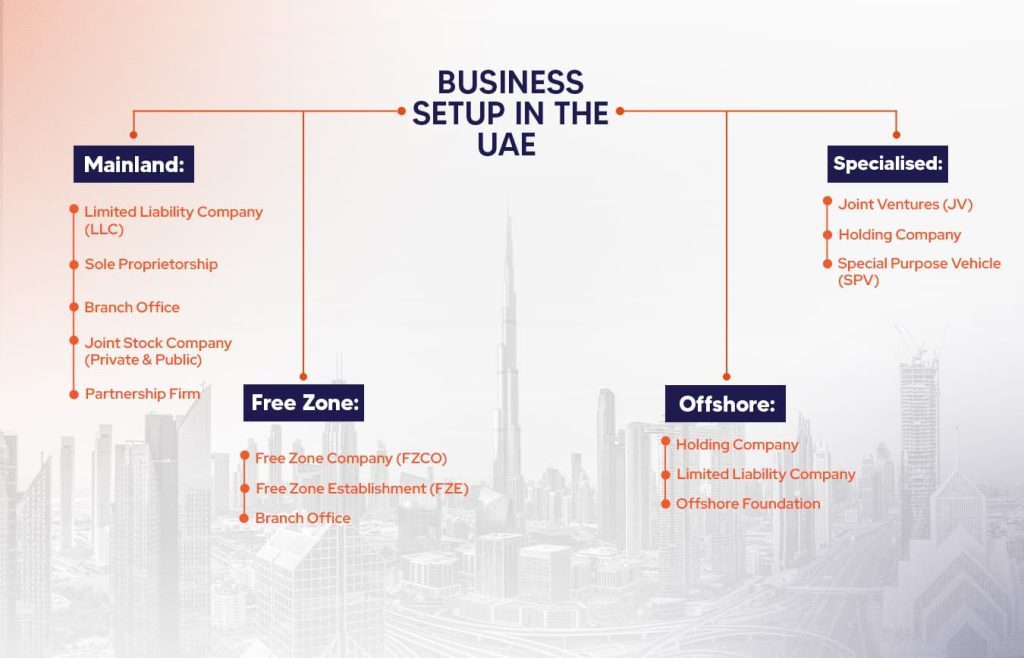
Here is a complete list of common business structures available for startups in the UAE, along with their features, benefits, costs, and who they suit.
| Business structure | Owners | Liability | Cost of business license | Benefits | Disadvantages | Best for |
|---|---|---|---|---|---|---|
| Sole proprietorship | One person | Unlimited personal liability | AED 7,000* onwards | -100% ownership -No profit sharing -Easy setup | -Limited to professional activities (for expats) -Limited expansion | -Freelancers -Consultants -Marketing professionals -Home-based businesses |
| Branch office | Varies | Varies | AED 12,000* onwards | -No local shareholder needed -Ready-made reputation of the parent company | -Restricted activities (to what parent company does) | -Global companies -Seeking expansion to UAE |
| Partnership | 2 or more | Limited or unlimited, depending on type | AED 7,000* onwards | -Combined capital and skills -Shared risks | -Unlimited joint liability (for general) -Difficult exit for partners -Partner conflicts | -Skill-based partnership -Family businesses |
| Free zone company | 1, 2 or more | Owners are personally liable | AED 12,500* onwards | -100% ownership -Tax reliefs -Easy setup | -Limited mainland access -Limited visas | -Startups -Innovative businesses |
| Offshore entities | Varies | Depends | AED 19,000* onwards | -Tax exemptions on international transactions -Full ownership -No office requirement | -Prohibited trade within UAE -No visa eligibility -Strict compliance | -Holding assets -Holding IPs -Global businesses |
Factors to Consider When Choosing Business Structure UAE
Evaluate a business structure in UAE against these factors before choosing it:
Personal finance protection
A key difference between various legal structures is the liability they place on you. In a sole proprietorship, liability is unlimited. However, structures like an LLC offer limited liability.
Desired business ownership
In some structures like LLCs and PJSCs, you may need a local Emirati partner. Also, management is jointly handled by multiple shareholders. On contrast, sole proprietorships and Free Zone Establishments (FZE) provide 100% ownership and full control.
Future flexibility
The right business structure should allow you to grow as per your plans. For example, if you are in a high-growth industry that requires external funding, a corporate structure works better to attract investors. In that case, being a solo business owner may be restrictive (money shortages, etc.).
The hidden costs
Capital requirements and initial registration fees vary across legal structures. Setting up a company with multiple shareholders is typically more expensive than a 2-partner firm. Besides, there may be ongoing expenses, such as:
- Annual auditing costs
- License renewal costs
- Capital raising costs (for companies selling shares)
- Documentation costs for MOA & AOA
Dubiz fact: Most structures like LLCs do not require paid-up capital, but it is still mentioned in the MOA.
Business activity
While starting a company, your business activity would influence your structure choice.
Talking about his experience with clients, a senior Dubiz license advisor says that trading and manufacturing businesses usually go for LLC company structuring in Dubai. Whereas sole proprietors are the ones opening consultancies, small retail, and e-commerce licenses.
Tax implications
Each business structure in UAE has different tax implications:
- LLCs, branches, and onshore entities: 9% corporate tax on income exceeding AED 375,000.
- Free zone entity: 0% corporate tax for “Qualifying Free Zone Person”.
- Import/export tax exemptions (in specific cases)
- 100% tax exemption on dividends or capital gain.
- 100% repatriation of profits to the home country.
Does Jurisdiction (Mainland, Free Zone, Offshore) Impact Structure Choice?
Yes, it does.
In the UAE, you can start a business in the mainland, free zone, or offshore. Each jurisdiction lets you register specific legal entities. To simplify it further for you, we have detailed the types of company formation in Dubai in each jurisdiction.
Related Insight: Free Zone vs. Mainland UAE: Differences Explained
Business Structures in Mainland UAE
Mainland entities are licensed by the Department of Economic Development (DED). The common types of legal structures that can be registered in the mainland include:
Limited Liability Company (LLC):
A limited liability company is owned by 1 to 50 shareholders, who are not personally liable for business debts. LLC remains one of the most popular business structures in the UAE due to its flexibility.
Trade licenses for LLC companies in the Dubai mainland:
- Commercial license
- Industrial license
- Professional license
- Tourism license
- Agricultural license
Capital requirement: LLCs must mention (not pay) share capital (e.g., AED 100,000 or more) in the company’s articles.
Office requirement: In most cases, it is mandatory to have physical office space.
Sole proprietorship:
A sole proprietorship is a business started by a single person. Features of a sole proprietorship include:
- 100% ownership: The trade license is issued exclusively under your name
- Absolute control: Make decisions independently and retain full profits
- Easier to set up: Lower costs and fewer administrative hurdles
- Unlimited liability: Personal assets can be used to settle business debts
- Local service agent appointments for foreign entrepreneurs: Helps with licensing and administrative work. Does not take any stake in the business.
- License options: Only for foreigners, it is restricted to professional services. No limitations for UAE citizens.
Branch office:
If you already own a company located in a foreign country or within the GCC, you can open its branch or a representative office in the UAE. The branch operates under the same name and carries out the same activities as the parent company.
- Local sponsor requirement: Foreign entities looking to open a branch in the mainland UAE must appoint a Local Service Agent (LSA). They assist with application processing, license approvals, permits, and visas.
- Representative branch office: If working as a representative office, it would be limited to promotional and support activities.
Joint Stock Company (public or private):
A joint stock company is a type of company where the capital is divided into equal shares and distributed among shareholders. Each shareholder’s liability is limited to their shares. It can be either of these:
- Private Joint Stock Company: Requires at least 2 shareholders and a minimum capital of AED 5,000,000. Shares are held privately and are not publicly traded.
- Public Joint Stock Company (PJSC): Shares are offered to the public and can be bought and sold on recognized stock exchanges. The minimum capital requirement is AED 10 million. Has at least 10 founding members and a board of 3 to 15 directors.
Joint stock companies are governed under the UAE Commercial Companies Law. Based on your business activity, you may need a UAE national partner holding up to 51% stake.
Partnership firm:
A partnership is a business structure in UAE where two or more individuals combine their resources to start a company and share the profits, losses, and risks. It can take three forms:
- General partnership: All partners have unlimited liability.
- Limited partnership: Each partner’s liability is limited to their agreed contribution.
- Civil company: Professionals from the same field (such as doctors or IT professionals) come together to start a company. A local service agent is mandatory in this case.
Business Structures in UAE Free Zones
There are more than 50 free zones in the UAE that offer business licenses to local and foreign entrepreneurs. Here are the popular legal structures in UAE free zones:
Free Zone Company (FZCO):
A free zone company has two or more shareholders. Shareholders can be individuals or corporations. Each shareholder has limited liability.
Free Zone Establishment (FZE):
A free zone establishment is an entity with a single shareholder. It is different from a sole establishment as it is a separate legal entity. Here, personal assets are completely isolated from business obligations. Also, you can start an FZE with 100% foreign ownership without the need for a local agent.
Branch of a foreign company:
Similar to the mainland, foreign companies can also establish a branch in a free zone. This allows them to access free zone benefits such as tax exemptions, 100% ownership, and advanced infrastructure.
Types of Offshore Entities
Offshore businesses in the UAE (RAKEZ, JAFZA, or Ajman Free Zone) are established for purposes like international trading and holding assets. They get access to UAE banking services, tax exemptions, and other benefits.
Legal structures in offshore UAE include:
- Holding company
- Limited liability company
- Offshore foundation
Specialised Types of Company Formation in Dubai
Other than the primary business structures, you can consider setting up these specialized entities:
Joint ventures (JVs):
Multiple entities can start a joint venture together to pursue a common objective or a specific project. JVs are temporary arrangements.
Ever came across a Hero Honda motorcycle? That is a real-life example of a successful joint venture between India’s Hero Group and Japan’s Honda Motor Company.
Holding company:
A holding company owns shares in other companies, often its subsidiaries. It does not produce goods or services itself.
A common example of a holding company would be Meta Platforms, Inc. It owns and controls Facebook, Instagram, WhatsApp, and Threads.
Special purpose vehicle:
Shortly known as SPVs, special purpose vehicles are legal entities used for estate planning, holding investments in real estate, or raising funds. SPV company setup in DIFC and SPV business setup in ADGM are two popular options in UAE.
Fun fact: SPVs can have more than 100 shareholders, making them perfect for large-scale projects.
Steps to Choose a Business Structure in UAE Smartly
Choosing a company form in UAE is more about vision than rigid rules. Be smart:
1. Picture your business for the next 5 years
Legal structure should not just support your business today, but also your future goals.
Ask yourself:
- Will you launch new products or services?
- Would you be entering new markets or regions?
- Do you see yourself bringing in investors or partners?
- How do you plan your exit?
2. Do not follow others blindly (most common mistake)
Budgets, goals, and risk appetite make every setup different. Your legal structure should match your personal and business needs, not someone else’s choice.
For example: Your friend, working as a branding consultant, might be fine with a sole proprietorship. But if you plan to build a full-stack marketing agency, bringing in partners with distinct specialisations could be a better choice.
3. Get hands-on advice from professionals
Do not wait for the wrong structuring mistake. Trust professional business setup consultants in the UAE for better decision-making.
At Dubiz, for example, we have helped businesses of all sizes and forms, across all possible industries. Through this experience, we understand better what works best for different business needs.
Changing the Structure of UAE Companies
With careful planning, you can change the existing structure of your UAE company to one that is more suitable. Key steps include:
- Evaluate current needs: Understand the new structure your business will have, based on liability, tax, and ownership.
- Seek professional guidance: A lawyer or business setup expert can help with the necessary steps and documentation.
- Management of company documents: The new company structure and ownership changes should be reflected in the MOA and AOA. These documents might need amendments.
- Get regulatory approval: To change the structure, you may need approval from the DED or the relevant free zone authority.
- Revise license: You may need a revised trade license reflecting the new structure, new shareholders, or expansions.
- Notify stakeholders: Partners, clients, and suppliers must be informed of the changes.
Choosing a Business Structure Dubai with Dubiz Helps
Strategic company structuring in the UAE today will benefit your business tomorrow. With so many options available, it is natural to feel confused. Consulting experts at Dubiz ensures your company is set up correctly from the start, helping you choose what works best, both strategically and cost-wise.
What makes Dubiz a better choice?
- We offer free consultation – no strings attached
- Mainland, free zone, and offshore business setup experts
- Customized business setup packages across the UAE
- Transparent pricing – no hidden costs
- Post setup support (PRO services, amendments)
Contact us today:
📞 Call: +971 56 369 5485
💬 WhatsApp: +971563695485
📧 Email: info@dubiz.co
Frequently asked questions (FAQs)
1. What is the structure of a business?
A business structure is the legal setup of a business that defines who owns it, how profits are shared, who makes decisions, and how assets and debts are handled.
2. What is the best legal structure for foreign investors in UAE?
The best legal structure for foreign investors in the UAE depends on their activity and goals. But generally, free zone companies and LLCs are mostly preferred.
3. Do I need a partner to start a company in Dubai?
Not always. Many activities now allow 100% foreign ownership on the mainland as well, along with free zones.
4. What is the most affordable business structure in UAE to register?
Usually, a sole proprietorship is more affordable as it requires only one owner and has fewer regulatory requirements. License cost starts at AED 7,000*.
5. What are the accounting and tax obligations for companies in UAE?
UAE companies must register for corporate tax, file returns if income exceeds AED 375,000, register for VAT (if applicable), and maintain financial records.
6. Can I change the company’s legal structure later?
It is possible. However, it is better to choose the right structure from the start. You can change the company structure if needed, but it involves time, cost, and effort.
7. Can a free zone company operate across the UAE?
Not directly. To operate in the mainland, a free zone company needs a permit from the Department of Economy and Tourism (DET) of the respective emirate.
8. In how long can I register a business in Dubai?
It can take a few days to a couple of weeks to register a business in Dubai, depending on your application, approvals, and completion of formalities.
9. Can I own 100% of a mainland company in UAE?
Yes, in most cases, you can own 100% of mainland company in UAE. Certain strategic sectors may have exceptions.
10. Do all structures need a physical office?
No. In free zones, you can choose a virtual office or flexi-desk, depending on the activity.
11. How do I register a limited liability company in the UAE?
To register a limited liability company in the UAE, select your business activities, reserve a trade name, get government approvals, prepare company and shareholder documents, obtain office space, and apply for a trade license with DED (or free zone).